California Wildfires: Fire Season, Largest Fires and Santa Ana Winds
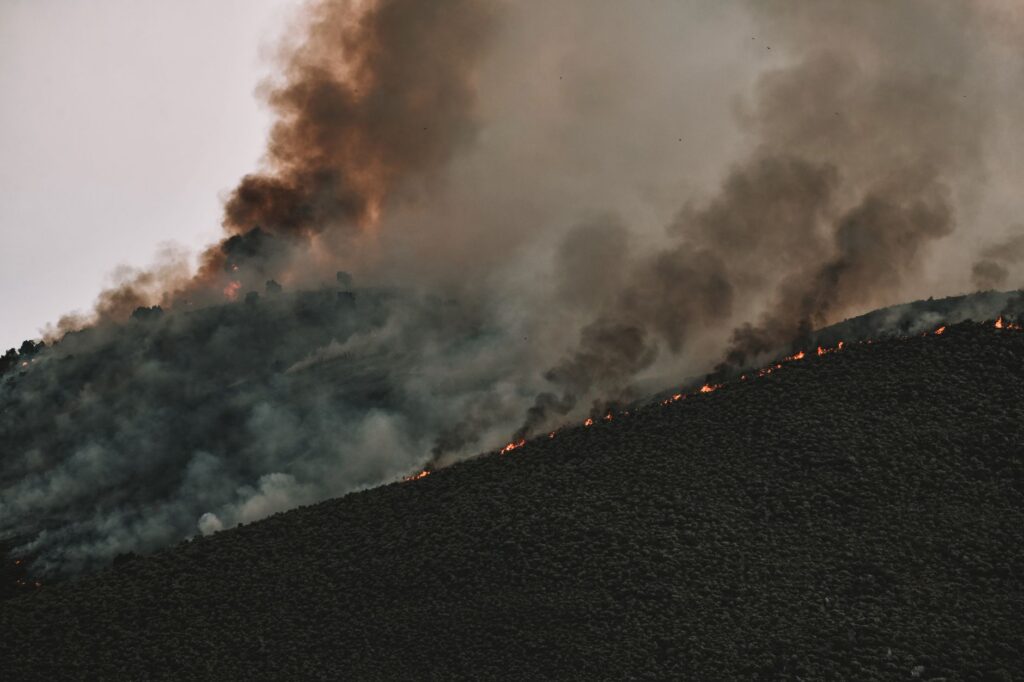
California’s fire season usually runs from late spring through fall, with Northern California peaking in summer and Southern California staying active into autumn, when Santa Ana winds blow. The largest wildfire in state records is the August Complex of 2020, at 1,032,648 acres. Acreage and containment figures come from the agency managing each fire, most often CAL FIRE or a federal agency, and the National Interagency Fire Center tracks the national totals.
When is wildfire season in California?
There is no fixed start date. Fire season depends on how much rain and snow fell the winter and spring before, on heat waves and wind events, and on how dry the vegetation is, according to the list of California wildfires on Wikipedia.
- Northern California typically sees fires from late spring to early fall, with the peak in summer. Cold fronts can bring wind and lightning.
- Southern California peaks between late spring and fall. Offshore, downslope winds can create critical fire weather there, while onshore flow and Pacific storms slow fire growth.
Climate change has made California’s fire season longer and more extreme since the middle of the 20th century. Since the early 2010s, fires have also grown more dangerous because of fuel buildup in forests, more people living near wildland and aging power lines.
How many acres burn in California each year?
It changes a lot from year to year. California covers 99.8 million acres, and since 2000 the area burned each year has ranged from 90,000 acres to 4,397,809 acres. The worst year in that record was 2020, with 9,639 fires and 4,397,809 acres burned. Other big years were 2021 (2,568,948 acres) and 2018 (1,975,086 acres). In 2025, 8,036 fires burned 525,223 acres.
From 2000 to 2025, the mean was 935,565 acres a year and the median was 647,537 acres. The National Interagency Fire Center began keeping more accurate state-by-state acreage records in 2001.
What are the largest wildfires in California history?
CAL FIRE keeps the official ranking of the largest fires since 1932. As of Oct. 2, 2024, the top five were:
- August Complex (lightning), August 2020: 1,032,648 acres, 935 structures destroyed, 1 death.
- Dixie (power lines), July 2021: 963,309 acres in Butte, Plumas, Lassen, Shasta and Tehama counties, 1,311 structures.
- Mendocino Complex (human-related), July 2018: 459,123 acres.
- Park (arson), July 2024: 429,603 acres.
- SCU Lightning Complex (lightning), August 2020: 396,625 acres.
The Dixie Fire is the largest single-ignition fire in recorded California history. A complex, like the August Complex, is a group of fires from several ignition points managed together. The Dixie Fire started July 13, 2021, when a tree fell on a Pacific Gas and Electric distribution line in the Feather River Canyon, and it was declared 100 percent contained on Oct. 25, 2021. It was the first fire known to burn across the crest of the Sierra Nevada, and its suppression cost of $637.4 million made it the most expensive wildfire to fight in U.S. history.
What are Santa Ana winds and why do they spread fires?
The Santa Ana winds are strong, very dry winds that start over the Great Basin and blow down through mountain passes toward coastal Southern California and northern Baja California. As the air sinks it warms and dries out, and relative humidity often falls below 10 percent. Speeds can easily exceed 40 miles per hour, and the winds are the main driver of most wildfires in Southern California.
- About 10 to 25 Santa Ana events happen in a typical year.
- An event lasts one to seven days, three days on average.
- The longest on record lasted 14 days, in November 1957.
- The winds behind the January 2025 Southern California wildfires came and went over 24 days.
They are most common in autumn but can occur at other times of year. Forecasters often watch the pressure difference between Los Angeles International Airport and Las Vegas: a gap of 9 millibars is enough to support a Santa Ana event. In Northern California, similar dry offshore winds are called Diablo winds.
What starts most California wildfires?
On lands where CAL FIRE has fire protection responsibility, most ignitions since 1980 have been caused by people. The four most common sources, in order, are equipment use, power lines, arson and lightning. More than 2.7 million Californians live in “very high fire hazard severity zones,” including more than 350,000 people in towns that sit entirely inside them.
Who reports acres burned and containment?
The agency managing a fire publishes its size in acres and its containment, the share of the fire’s edge that crews have secured with a control line. On state-protected land that is usually CAL FIRE; on national forests it is the U.S. Forest Service; local agencies report fires in their own areas. Our guide to what percent contained and acres burned mean explains how to read these numbers.
For the national picture, the National Interagency Fire Center publishes a fire report with large fires by state, their size and containment, and year-to-date totals. That report is currently updated on Fridays. As of Nov. 6, 2026, NIFC counted 68,179 fires nationwide this year, burning 9,471,008 acres, or 131% of the 10-year average number of fires and 146% of average acres for the date.
For evacuation orders and safety instructions, follow your county emergency officials, the fire agency in charge and the National Weather Service, which issues red flag warnings for critical fire weather. Smoke can affect health far from the flames, as research on wildfire smoke during pregnancy has found.
Quick answers
What was California’s worst fire year?
By area burned, 2020: 9,639 fires burned 4,397,809 acres, about 4.4% of the state’s land.
Is the Dixie Fire the largest fire in California?
It is second overall, behind the August Complex, and the largest that started from a single ignition.
How long do Santa Ana winds last?
One to seven days, three on average. The longest recorded event lasted 14 days in November 1957.
Where can I check active fire sizes?
Check the fire agency managing the incident, such as CAL FIRE or the U.S. Forest Service, and NIFC’s national fire report for totals.
Checked against official sources in November 2026. Alert criteria, records and guidance are revised: check the official agency page for current information.