Study Ties 1995 Wildfires to a New Kind of Permafrost Landslide
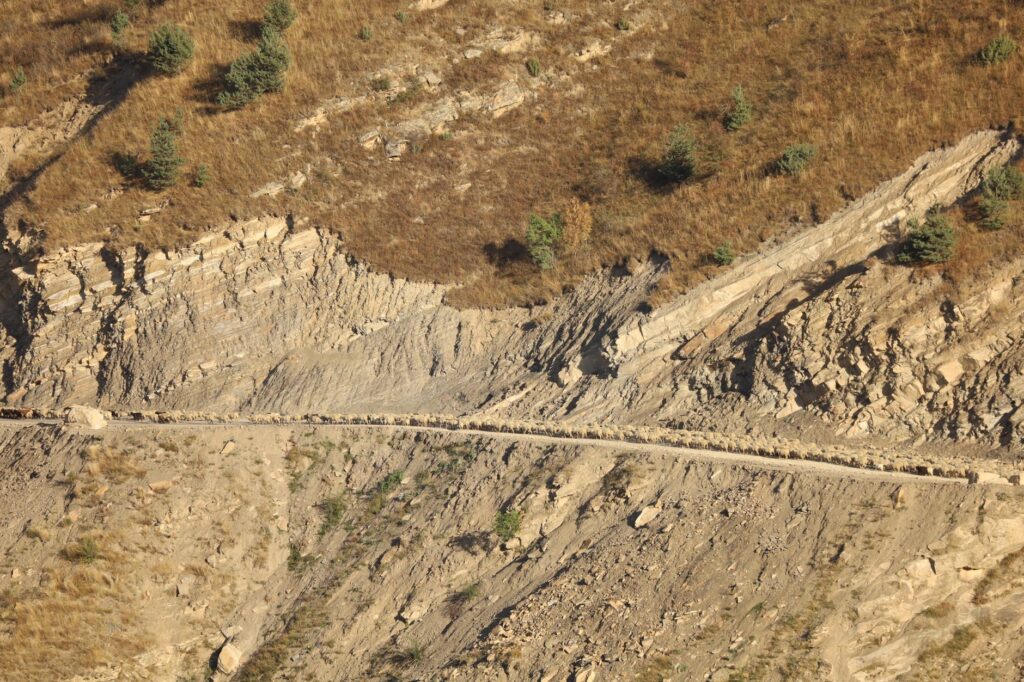
Researchers say two large landslides in the central Mackenzie Valley of Canada’s Northwest Territories, in 2017 and 2018, belong to a type of slope failure that had not been described before. They call them “permafrost detachment slides.” Their study, published in September in the journal Geophysical Research Letters, proposes that severe wildfires in 1995 set the slides in motion by slowly warming the frozen ground from below.
The authors say slides of this kind may happen more often as the planet keeps warming, Smithsonian Magazine reported.
Two slides that left frozen blocks behind
The team studied the Johnson River slide of August 2017, which moved about 4.5 million cubic meters of dirt and rock, and the Redstone River slide of August 2018, which sent roughly 18 million cubic meters of debris downhill. One of the two dammed a river and formed a lake.
Permafrost is ground that stays frozen year round. When it fails, it usually thaws from the top and flows downhill as mud. Study co-author Joseph Young, a geoscientist who did the work at the University of Alberta, told Live Science that these slides were different: the debris held blocks of material that was still frozen. To the researchers, that pointed to a failure starting deep in the ground rather than at the surface.
The project began in 2019. During fieldwork, the team saw large landslide scars in valleys they had known as stable permafrost, according to Live Science.
How a fire can weaken permafrost from below
The researchers used satellite images taken between 1980 and 2020 along with field studies. From September 2020 to August 2022 they also tracked ground temperatures near the 1995 burn area and in undisturbed forest for comparison, then put those readings into computer simulations.
Their explanation goes like this. The fires burned off the vegetation that normally shades the permafrost and keeps it cool on sunny days. Over time, that extra heat worked its way down. Young told Grist that after about 20 years the warming from a burned forest can reach the base of the permafrost, though the effect is slight.
As the bottom of the frozen layer warmed, it weakened and cracked. Water seeped into the cracks and thawed it further, until the ground broke loose at its base. The two slides are among more than 150 permafrost landslides in the area that occurred roughly two decades after the severe wildfires, so the same process could have played a part in many of them, according to the study.
Why it matters for northern slopes
Young described the slides to Grist as “a very dramatic manifestation of the changing climate.” He said they have only started appearing in the last 10, 15 years and change the landscape suddenly and sharply.
Dmitry Nicolsky, a geophysicist at the University of Alaska Fairbanks who was not part of the research, told Science News that scientists need to look more closely at what happens beneath the surface in permafrost regions. Ground there could move “slowly or it might go catastrophically,” he said.
The process also leaves warning signs. Young told the CBC that a detachment slide does not form overnight. It builds over about 20 years after a fire, as the slope creeps slowly downhill, and he said that gives experts a chance to spot signs of a coming slide and predict when it will happen.
Permafrost covers a large share of the north. The Northern Hemisphere’s permafrost regions span an area nearly 2.5 times the size of the contiguous United States, according to Smithsonian Magazine.
Source: Smithsonian Magazine