Kīlauea Eruption Explained: Episodes, Alert Levels and Vog
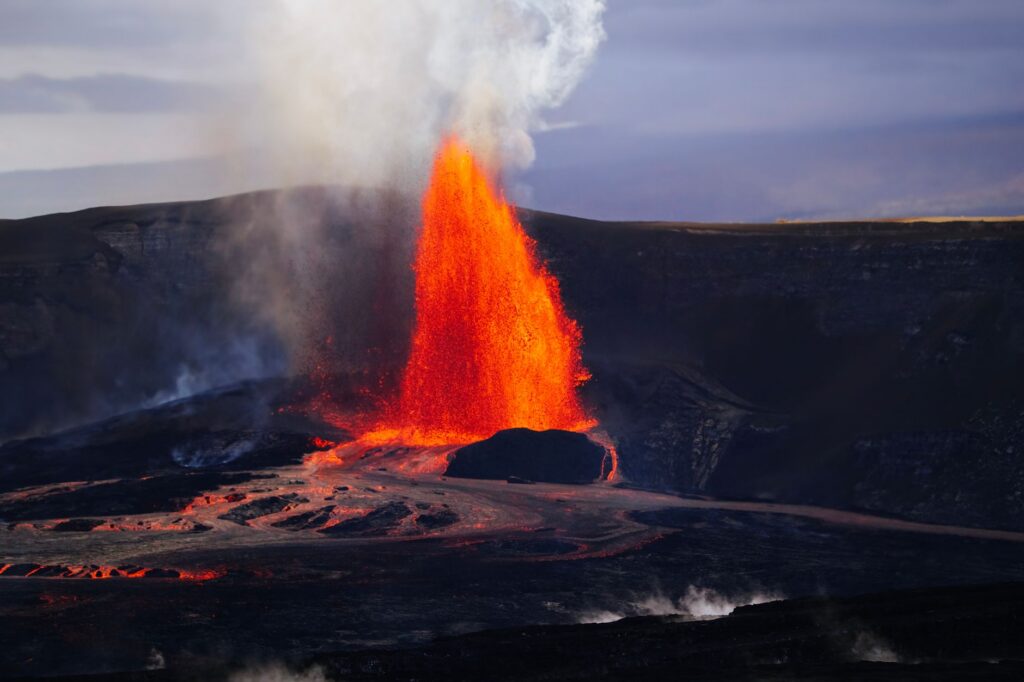
Kīlauea, on the Island of Hawaiʻi, has been erupting episodically from vents inside Halemaʻumaʻu crater at its summit since December 23, 2024. The USGS Hawaiian Volcano Observatory (HVO) numbers each burst of high lava fountaining as an episode, and episode 56 lasted about six hours on November 5, 2026. As of HVO’s November 8, 2026 update, the eruption was paused, the Volcano Alert Level was ADVISORY and the Aviation Color Code was YELLOW.
HVO said on November 8 that the summit was reinflating and the next fountaining episode was likely several weeks away. Conditions can change within hours, so check the HVO volcano updates for Kīlauea for the current status.
What is happening at Kīlauea right now?
The eruption follows a repeating cycle. Magma refills the summit reservoir and the ground inflates, which HVO measures with tiltmeters. Lava then rises in the vents, often with smaller overflows, before a high fountaining episode. When the episode ends, the summit deflates and the cycle starts again.
According to HVO, fountaining episodes generally last less than 12 hours and are separated by pauses of two or more weeks. The pauses have grown longer. In April 2026, HVO said they had lengthened from a few days early in the eruption to more than three weeks. On October 7, 2026, the National Park Service noted that 43 days had passed since the August 25 episode, the longest gap since the eruption began.
HVO says the lava flows of this eruption have stayed inside Halemaʻumaʻu crater and on the southwest side of Kaluapele, Kīlauea’s summit caldera, within a closed area of Hawaiʻi Volcanoes National Park. HVO also warns that recent intrusions show the location of activity could change. On September 30 and October 1, 2026, magma pushed into a sheet-like body called a dike near the surface north of Halemaʻumaʻu. About 130 earthquakes accompanied it, the largest a magnitude 3.5, and satellite images showed new small cracks on the caldera floor.
How does HVO report an episode?
HVO uses several kinds of messages, and each one has a different job.
| Product | When HVO issues it | What it contains |
|---|---|---|
| Daily Update | Every day | Alert level, summit tilt, seismic tremor, sulfur dioxide, rift zone status and the outlook for the next episode |
| Volcano Activity Notice (VAN) | When an episode starts or ends, or the alert level changes | Fountain height, plume height, wind direction and hazards |
| Volcano Observatory Notice for Aviation (VONA) | When the color code changes or conditions change significantly | Aviation color code and ash cloud height for pilots and air traffic |
| Status Report | After notable events | Longer analysis, such as the October 2026 report on the summit dike intrusion |
| Observatory messages | During an episode | Short updates as activity develops |
HVO also publishes forecast windows for the next episode, based on tilt, seismic and gas data and on how earlier episodes behaved. Before episode 56, HVO forecast a start between November 4 and 7. When large precursory overflows began on November 2, it revised the window to November 2 through 7. Episode 56 started on November 5. HVO says this low-level precursory activity can continue for hours to days before fountaining begins.
What happened during episode 56?
HVO’s summary of the November 5, 2026 episode:
- Lava fountaining lasted from 12:10 p.m. to 6:01 p.m. HST, and only the north vent produced fountains.
- Fountains reached about 660 feet (200 meters).
- The eruptive plume rose as high as 18,000 feet (5,500 meters) above sea level, as reported by the National Weather Service and the Washington Volcanic Ash Advisory Center.
- About 8 million cubic yards (6 million cubic meters) of lava erupted, based on tiltmeter data.
- Tephra fell mainly to the southwest, in closed areas of the park, with trace amounts on Highway 11.
How do alert levels work at Kīlauea?
Since April 2026, HVO lowers Kīlauea to ADVISORY/YELLOW at the end of each episode. That means activity has decreased significantly but is closely monitored for the buildup to the next fountaining. HVO raises the volcano to WATCH/ORANGE when an episode starts, meaning an eruption is underway but poses limited hazards. HVO said it would raise Kīlauea to WARNING/RED only if hazardous fallout and significant ash emissions occur.
For episode 56, HVO moved to WATCH/ORANGE on November 2, when the precursory overflows began, and back to ADVISORY/YELLOW on November 6. The volcano alert levels guide has the full USGS definitions.
What is vog, and where does Kīlauea’s gas go?
Vog is volcanic air pollution. HVO explains that the eruption releases water vapor, carbon dioxide and sulfur dioxide (SO2), and that SO2 reacts in the atmosphere to form vog downwind. During pauses between episodes, HVO says summit SO2 emissions are typically several thousand tonnes per day. After the overflows began on November 2, 2026, they averaged about 4,000 tonnes per day.
Wind decides where the vog goes, and HVO’s daily update names the direction. On November 8, 2026, trade winds were carrying volcanic gases southwest toward Kaʻū. HVO says SO2 and vog may cause respiratory and other problems at high concentrations, and that gas can remain hazardous right downwind of the vents even when they are not erupting. The National Park Service says hazardous volcanic gases can be a danger to sensitive groups and advises visitors to check air quality often. For how air quality readings work in general, see the Air Quality Index guide.
Lava fountains also produce tephra: small glassy fragments such as ash, pumice, scoria and Pele’s hair. HVO says tephra fall from ash clouds is greatest within 3 miles (5 km) of the vents, while light particles can drift much farther. HVO asks residents and visitors to minimize exposure, because the fragments can irritate skin, eyes and airways.
What is closed in Hawaiʻi Volcanoes National Park?
The eruption is inside a closed area of Hawaiʻi Volcanoes National Park, and closures change with activity. HVO notes that the caldera rim around Halemaʻumaʻu crater, where crater wall instability, ground cracking and rockfalls are hazards, has been closed to the public since early 2008.
On October 7, 2026, the National Park Service closed Halemaʻumaʻu Trail and part of Byron Ledge Trail, about 1.3 miles of trail descending to the caldera floor. The park cited more than 200 shallow earthquakes in a week and the new cracks from the September 30 intrusion. Viewing areas on the Keanakākoʻi side of the caldera had closed the week before.
NPS lists eruption viewing areas on the caldera rim, such as Uēkahuna and Kīlauea Overlook, and advises checking webcams and the USGS daily update before visiting. Which areas were open after October 7 could not be confirmed for this guide, so use the park’s alerts and conditions page on the day you go.
How can you follow the eruption?
- Read the HVO Daily Update for the alert level, the latest tilt and gas data and the outlook for the next episode.
- Check the USGS Kīlauea eruption timeline for the dates of past episodes.
- Watch the HVO webcams, and during episodes the three USGS summit livestreams on YouTube.
- Subscribe to the USGS Volcano Notification Service for VANs and VONAs, or call HVO’s Kīlauea activity summary line at (808) 967-8862.
- Follow Hawaiʻi County Civil Defense and the active NWS alerts for Hawaii for local instructions. Our list of US volcanoes with elevated alert levels and recent earthquakes in Hawaii show the USGS data in one place.
Bottom line
Kīlauea’s eruption runs in short fountaining episodes separated by pauses of weeks. HVO reports each stage with a daily update, notices when an episode starts and ends, and a forecast window for the next one. As of November 8, 2026, the eruption was paused at ADVISORY/YELLOW after episode 56. Park closures and gas conditions change quickly, so check HVO and the National Park Service on the day you go.
FAQ
Is Kīlauea erupting right now?
HVO treats the eruption that began on December 23, 2024 as ongoing, with pauses between episodes. As of November 8, 2026, it was paused after episode 56, and HVO said the next episode was likely several weeks away.
How long does a Kīlauea episode last?
HVO says fountaining episodes generally last less than 12 hours. Episode 56 lasted just under six hours. The overflows that come before an episode can go on for hours to days.
Can you see the lava from the park?
During earlier 2026 episodes, NPS said activity could be seen from open viewing areas on the Kīlauea caldera rim, and USGS streams the summit on YouTube. Which overlooks are open changes with conditions, so check the park before going.
Is the eruption threatening homes?
HVO says the vents and lava flows of this eruption have stayed inside the summit caldera within the closed park area. HVO also says an intrusion could move the location of activity, so follow Hawaiʻi County Civil Defense for any local instructions.