Hurricane Categories Explained: The Saffir-Simpson Wind Scale
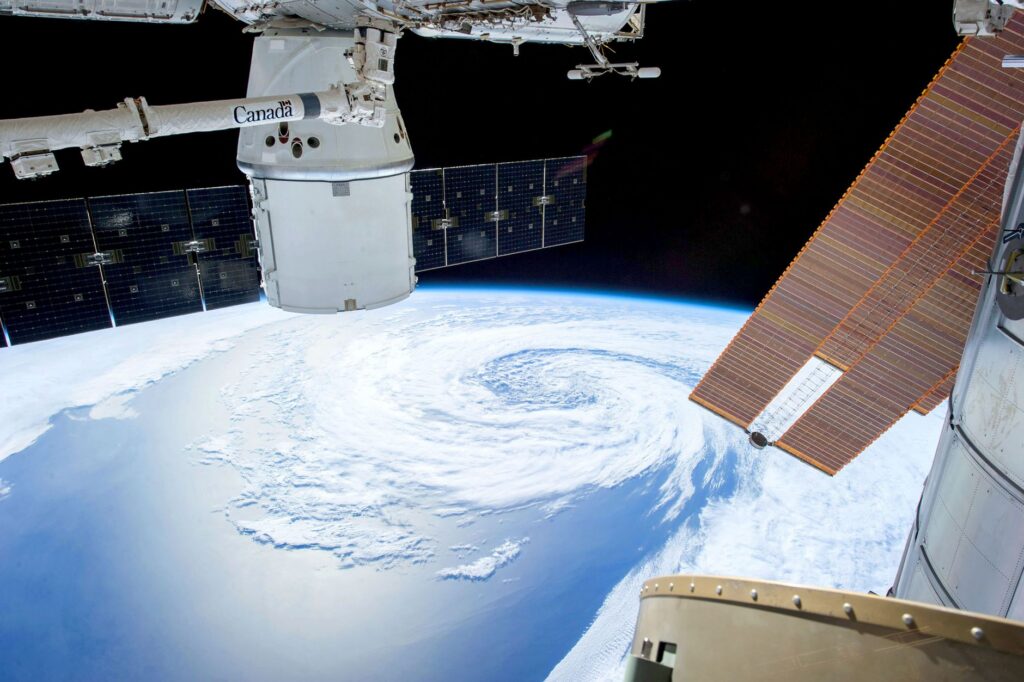
The Saffir-Simpson Hurricane Wind Scale rates hurricanes from Category 1 to Category 5 using only the storm’s maximum sustained wind. According to the National Hurricane Center (NHC), Category 1 starts at 74 mph (119 km/h) and Category 5 starts at 157 mph (252 km/h). The scale does not measure storm surge, rainfall flooding or tornadoes, and NHC says those hazards can be deadly in a hurricane of any category.
What are the five hurricane categories?
NHC publishes the scale in three units: miles per hour, knots and kilometers per hour. Forecasters assign intensity in knots, so the knot column is the one NHC works from. The damage summaries are NHC’s own headline wording for each category.
| Category | Sustained wind (mph) | Knots | km/h | NHC damage summary |
|---|---|---|---|---|
| 1 | 74–95 | 64–82 | 119–153 | Very dangerous winds will produce some damage |
| 2 | 96–110 | 83–95 | 154–177 | Extremely dangerous winds will cause extensive damage |
| 3 (major) | 111–129 | 96–112 | 178–208 | Devastating damage will occur |
| 4 (major) | 130–156 | 113–136 | 209–251 | Catastrophic damage will occur |
| 5 (major) | 157 or higher | 137 or higher | 252 or higher | Catastrophic damage will occur |
Source: NHC, Saffir-Simpson Hurricane Wind Scale.
What damage does NHC describe for each category?
NHC attaches examples of wind damage and power outages to every category. The examples describe buildings in the United States, and NHC notes that they depend on local building codes and how long those codes have been enforced.
- Category 1: well-constructed frame homes could have damage to roof shingles, vinyl siding and gutters. NHC says power outages could last a few to several days.
- Category 2: well-constructed frame homes could sustain major roof and siding damage. NHC expects near-total power loss, with outages lasting from several days to weeks.
- Category 3: well-built framed homes may lose roof decking and gable ends. NHC says electricity and water may be unavailable for several days to weeks after the storm.
- Category 4: well-built framed homes can lose most of the roof structure and some exterior walls. NHC says outages could last weeks to possibly months, and most of the area may be uninhabitable for weeks or months.
- Category 5: NHC says a high percentage of framed homes will be destroyed, with total roof failure and wall collapse. Outages and the time an area may be uninhabitable match Category 4: weeks to possibly months.
In NHC’s longer description of the scale, damage rises by about a factor of four for every category increase.
What is a major hurricane?
A major hurricane is a hurricane rated Category 3 or higher, which means sustained winds of 111 mph (178 km/h) or more. NHC uses the term in its advisories and maps. On the NHC cone graphic, a forecast point marked M is a major hurricane, and H is a hurricane with winds of 74 to 110 mph. NHC also notes that in the western North Pacific, the term “super typhoon” is used for storms with sustained winds above 150 mph.
How is the wind speed for a category measured?
The category depends on the maximum sustained surface wind. For the scale, NHC defines it as the peak 1-minute wind at a height of 10 meters (33 feet) over open, unobstructed ground. Gusts are stronger than sustained winds, but gusts do not set the category.
NHC and the Central Pacific Hurricane Center assign intensity in 5-knot steps, such as 100, 105 or 110 knots. For public products, the knot value is converted to mph and km/h and rounded to the nearest 5 mph and 5 km/h. That is why advisories show round numbers such as 130 mph or 150 mph.
NHC points out two local effects. Sustained winds can be stronger over hilly or mountainous ground, such as the Appalachians or much of Puerto Rico. Peak winds are believed to drop by about one category within a short distance inland, perhaps half a mile (about 1 km) from the coast, although NHC says exceptions are possible.
How has the scale changed since it was created?
NHC credits the original scale to wind engineer Herb Saffir and meteorologist Bob Simpson. Storm surge ranges appeared in the earliest published versions, dating back to 1972, and central pressure was also part of each category. When NHC dropped surge and pressure and kept peak wind as the only factor, the name became the Saffir-Simpson Hurricane Wind Scale.
The last change to the numbers came in 2012, when NHC widened Category 4 by 1 mph at each end. The old range was 131–155 mph (114–135 knots). The new range is 130–156 mph (113–136 knots, 209–251 km/h). The reason was rounding: a 115-knot storm converts to about 132 mph, which rounds to 130 mph and used to fall in the Category 3 mph range. NHC said the change did not alter the category of any storm in the historical record.
What does the Saffir-Simpson scale not measure?
The scale says nothing about storm surge, rainfall flooding or tornadoes. NHC states that these hazards can be deadly in any category and can require protective action, including evacuation.
Earlier versions, called the Saffir-Simpson Hurricane Scale, listed storm surge ranges and central pressure for each category. NHC removed them because surge depends on far more than wind speed: storm size, forward speed, the angle of approach to the coast and the depth of nearshore water. NHC gives two examples:
- Hurricane Ike (2008) made landfall in Texas as a Category 2 storm. Its hurricane-force winds extended as far as 125 miles from the center, and its peak storm surge was about 20 feet.
- Hurricane Charley (2004) struck Florida as a Category 4 storm. Its hurricane-force winds extended at most 25 miles from the center, and its peak storm surge was about 7 feet.
NHC’s storm surge overview calls surge the leading cause of fatalities from hurricanes. Wind damage also depends on how long strong winds last, changes in wind direction and the age of buildings, according to NHC.
Where can you see a storm’s current category?
NHC’s Tropical Cyclone Public Advisory gives each storm’s maximum sustained winds, which set its category. In the Atlantic, NHC normally issues public advisories every six hours, plus intermediate advisories every three hours when coastal watches or warnings are in effect. Our live list of active NHC storms shows the latest official advisory data in one place. The cone map marks forecast strength at each point, and our guide on how to read the NHC forecast cone explains the letters.
Bottom line
A hurricane’s category tells you its peak sustained wind and the wind damage NHC associates with it. Surge, rain and tornadoes have their own products and alerts, covered in our guide to hurricane watches and warnings. For decisions about evacuating or sheltering, follow your local emergency officials and your National Weather Service office.
FAQ
Is there a Category 6 hurricane?
No. The Saffir-Simpson Hurricane Wind Scale runs from 1 to 5, and Category 5 covers every storm with sustained winds of 157 mph (252 km/h) or more. NHC has no higher category.
How many Category 5 hurricanes have made landfall in the United States?
NOAA counts four on record: the Labor Day Hurricane (1935), Camille (1969), Andrew (1992) and Michael (2018). NOAA upgraded Michael to Category 5 in April 2019, after a post-storm review put its landfall winds near Mexico Beach, Florida, at 160 mph (140 knots).
Can a low-category hurricane still be dangerous?
Yes. NHC says storm surge, rainfall flooding and tornadoes can be deadly in any category. Hurricane Ike was a Category 2 storm at landfall and still produced a peak surge of about 20 feet.
What is a storm called below 74 mph?
Below 74 mph a storm is not on the Saffir-Simpson scale. NHC calls it a tropical storm at 39–73 mph and a tropical depression at 38 mph or less. Our guide to tropical depressions, storms and hurricanes covers those thresholds.