2022 Hunga Tonga Eruption: What Happened, Tsunami and Shockwave
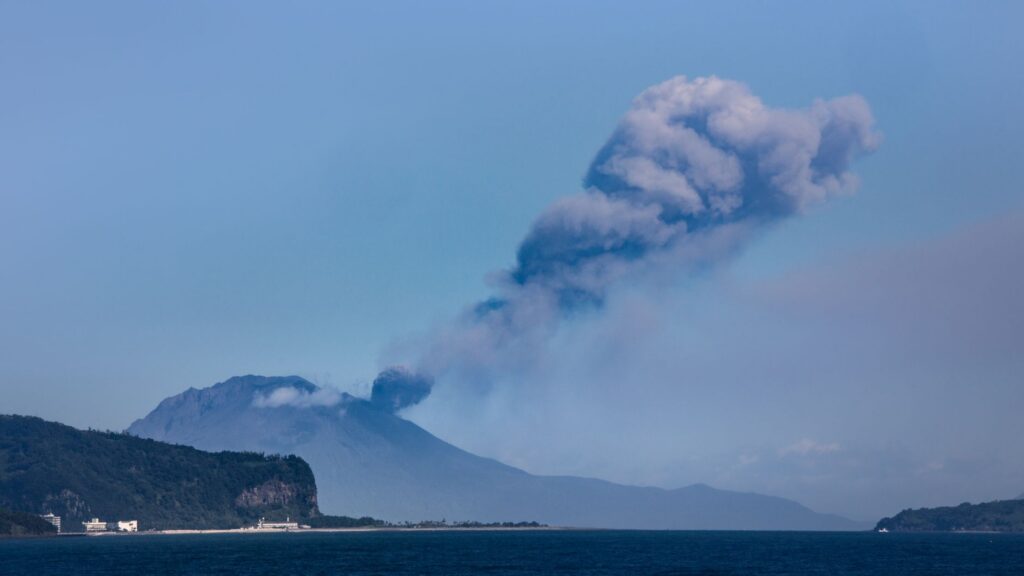
On Jan. 15, 2022, the submarine volcano Hunga Tonga–Hunga Haʻapai in the South Pacific erupted at its climax at 17:14 local time (04:14:45 UTC). It sent a column 58 km into the mesosphere, triggered a tsunami that reached coasts from Japan to Peru, and produced the largest atmospheric explosion recorded by modern instruments, according to Wikipedia’s article on the eruption and tsunami.
The volcano lies 65 km north of Tongatapu, Tonga’s main island. Its eruption was rated at least VEI 5 on the Volcanic Explosivity Index. For how it compares with other large eruptions, see this list of the largest eruptions and their VEI ratings.
What is Hunga Tonga–Hunga Haʻapai?
According to Wikipedia’s page on the volcano, it is a submarine volcano in the Tonga–Kermadec arc, a subduction zone where the Pacific Plate slides under the Indo-Australian Plate. It rises around 2,000 m from the seafloor. Before the eruption its caldera sat roughly 150 m below sea level and was 4 km at its widest.
Only two small uninhabited islands, Hunga Tonga and Hunga Haʻapai, reach above water. They formed parts of the caldera rim. An eruption in 2014 and 2015 joined them into one landmass, and the 2022 eruption separated them again and made them smaller. The volcano has seven historical recorded eruptions.
How did the 2021 and 2022 eruptions unfold?
An eruption began on Dec. 20, 2021, and sent a large ash plume into view from Nukuʻalofa, Tonga’s capital, about 70 km away. The first phase ended at 02:00 on Dec. 21. Plumes carrying sulfur dioxide drifted north-northeast on Dec. 22 and 23, and eruptions in the second half of December interrupted air travel to Tonga several times.
Tonga Geological Services declared the volcano dormant on Jan. 11, 2022. A large eruption began on Jan. 14 at 04:20 local time and sent ash 20 km high. Tonga’s government issued a tsunami warning, and waves of 30 cm were seen in Nukuʻalofa. The much larger Plinian eruption (a sustained, very powerful gas-and-ash blast) came the next day. Ash fell on Tongatapu and blotted out the sun, and many residents were stuck in traffic as they tried to reach higher ground.
How far was the blast heard and felt?
The explosion was heard in Samoa, about 840 km away, and people in Fiji, more than 700 km away, compared it to thunder. In New Zealand, more than 2,000 km away, the sound arrived two hours later. Around 3:30 a.m. local time, a series of bangs lasting about 30 minutes was heard in and around Anchorage, Alaska, roughly 9,300 km from the volcano. Booms reached Yukon in Canada, 9,700 km away. The U.S. Geological Survey estimated a surface-wave magnitude of 5.8.
The blast also sent an atmospheric pressure wave around the globe. Weather stations recorded a maximum amplitude of about 7 hPa in New Zealand, 6.9 hPa at Lord Howe Island, 3.3 hPa at Perth, 2.5 hPa in Switzerland and just over 2 hPa in the United Kingdom. The wave was reported to have circled the Earth as many as four times in Japan and Utah, and at least twice at the Blue Hill Meteorological Observatory in Massachusetts. It was also observed in Chennai, India, 12,000 km away.
What did the tsunami do?
The volcanic tsunami affected Tonga, Fiji, American Samoa, Samoa, Vanuatu, New Zealand, Japan, the United States, the Russian Far East, Chile and Peru. Waves up to 20 m high struck Tonga, and run-up heights reached 45 m on the uninhabited island of Tofua. Two people drowned in Peru when 2 m waves hit the coast, and another person died of indirect causes in Fiji. The same page lists 7 dead, 19 injured and others reported missing, with $182 million in damage in Tonga. The text of the article itself says at least four people were killed in Tonga, so figures differ between the summary box and the narrative. For another Pacific-wide wave event, see the 2004 Indian Ocean earthquake and tsunami.
Why it matters
The eruption displaced 10 cubic kilometres of rock, ash and sediment. Scientists described it as a “magma hammer”, with four underwater thrusts at its peak. It was the largest volcanic eruption since Mount Pinatubo in 1991. NASA determined it was “hundreds of times more powerful” than the Little Boy bomb. Only the 1883 Krakatoa eruption is thought to have rivalled its atmospheric disturbance in recent centuries.
Quick answers
When was the main Hunga Tonga eruption?
The climax came on Jan. 15, 2022, at 17:14 local time, after an eruption on Jan. 14 and a first phase on Dec. 20, 2021.
How high did the eruption column rise?
The Jan. 15 column rose 58 km into the mesosphere. The Jan. 14 eruption sent ash 20 km high.
Did the tsunami reach beyond Tonga?
Yes. It affected Fiji, Samoa, Vanuatu, New Zealand, Japan, the United States, Chile, Peru and other places listed above.
Checked against official sources in November 2026. Alert criteria, records and guidance are revised: check the official agency page for current information.