1815 Tambora to 2022 Hunga Tonga: Largest Eruptions and VEI
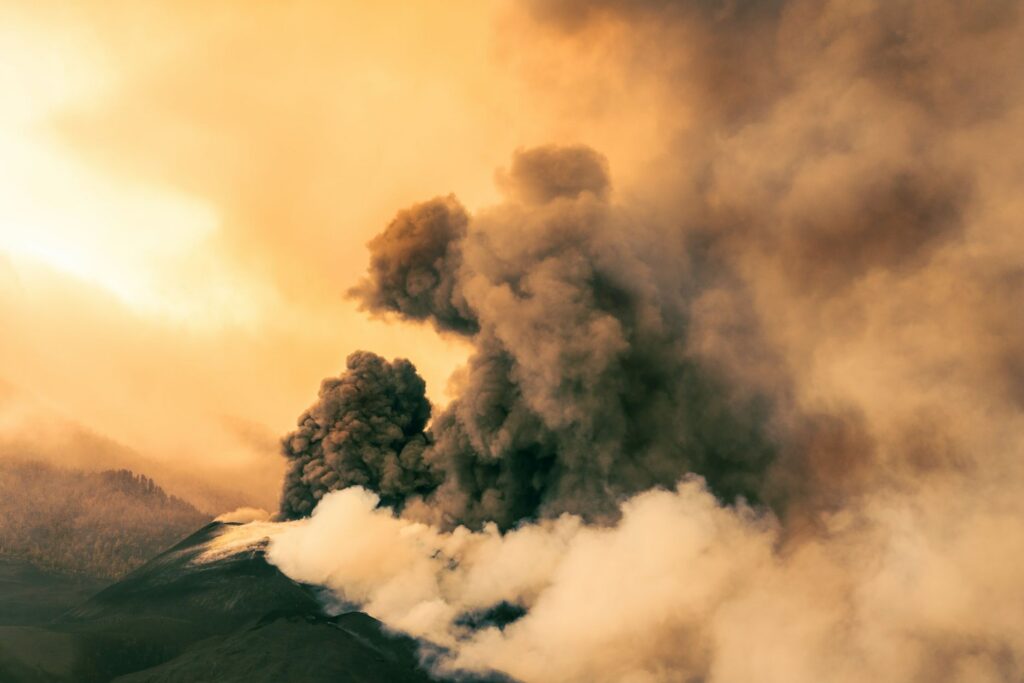
The volcanic explosivity index (VEI) ranks eruptions on a scale from 0 to 8, and each step up means roughly ten times more erupted material. On that scale Tambora (1815) is a VEI 7, Krakatoa (1883) and Pinatubo (1991) are both VEI 6, and Hunga Tonga–Hunga Haʻapai (2022) is a VEI 5. Eruptions that dwarf all of them are known from deep time, including Toba about 74,000 years ago.
The figures below come from Wikipedia’s article on the volcanic explosivity index and Wikipedia’s list of largest volcanic eruptions, which compile published scientific estimates.
What is the volcanic explosivity index?
The VEI measures the size of explosive eruptions. Christopher G. Newhall of the U.S. Geological Survey and Stephen Self devised it in 1982. It combines the volume of material thrown out, the height of the eruption cloud and qualitative descriptions that run from “gentle” to “mega-colossal.”
The scale is open-ended in principle, but the largest eruptions in history are given an 8. A VEI of 0 is a non-explosive eruption that ejects less than 10,000 cubic meters of tephra (the fragments of rock and ash a volcano throws out). A VEI 8 is a supervolcanic eruption that can eject 240 cubic miles of tephra, with a cloud column more than 20 km high.
How do the VEI levels compare?
From VEI 2 upward the scale is logarithmic: each step is an eruption about ten times larger by the ejecta criteria. The jump from VEI 1 to VEI 2 is a factor of one hundred, from 10,000 to 1,000,000 cubic meters. The table the scale uses for the upper levels reads like this:
- VEI 5: at least 1 cubic kilometer of ejecta, plume above 20 km, new eruptions of this size or larger about every 12 years.
- VEI 6: at least 10 cubic kilometers, plume above 30 km, every 50 to 100 years.
- VEI 7: at least 100 cubic kilometers, plume above 40 km, every 500 to 1,000 years.
- VEI 8: at least 1,000 cubic kilometers, plume above 50 km, more than 50,000 years apart.
Which famous eruptions fall at each level?
Tambora in 1815 sits at VEI 7, alongside Samalas (1257), Santorini (1600 BC) and Kikai (4300 BC). The VEI 6 group includes Krakatoa (1883), Pinatubo (1991), Novarupta (1912), Santa Maria (1902) and Huaynaputina (1600). Hunga Tonga–Hunga Haʻapai in 2022 is listed at VEI 5, the same level as Mount St. Helens in 1980 and Vesuvius in 79.
By the volume-and-height yardstick of the VEI, Hunga Tonga is one step below Krakatoa and Pinatubo and two below Tambora.
How big were the largest eruptions ever identified?
The VEI 8 class has about 40 eruptions identified over the last 132 million years, 30 of them in the past 36 million years. Other authors count at least 60 identified so far. The list of largest eruptions puts the youngest Toba Tuff, from Lake Toba in Indonesia, at 2,000 to 13,200 cubic kilometers, with most estimates at 2,800. The list’s other entries include the Wah Wah Springs Tuff (5,500 to 5,900 cubic kilometers, 30.06 million years ago), La Garita in Colorado (5,000 cubic kilometers, 27.8 million years ago) and Yellowstone’s Huckleberry Ridge Tuff (2,450 to 2,500 cubic kilometers).
Toba-sized eruptions occur worldwide every 50,000 to 100,000 years, according to the same source. The most recent VEI 8 eruption is Taupō’s Oruanui eruption in New Zealand, more than 27,000 years ago, estimated at 1,170 cubic kilometers. That means no Holocene eruption (the last 11,700 years) has reached VEI 8. There have been at least 10 of VEI 7 in that time.
Estimates for these deposits carry large uncertainty. One Yemen deposit, the Sam Ignimbrite, is listed at 6,797 to 6,803 cubic kilometers, but the source says the figure is uncertain by a factor of 2 or 3.
What does the VEI leave out?
The VEI treats ash, lava, lava bombs and ignimbrite alike and ignores how dense or gas-filled the material is. It also does not measure an eruption’s power output, which makes it hard to apply to prehistoric or unobserved eruptions. Scientists sometimes calculate the dense-rock equivalent (DRE) to estimate the actual amount of magma erupted.
The source adds that the VEI is not as significant as sulfur dioxide emissions for gauging an eruption’s atmospheric and climate effects. Two eruptions with the same VEI can differ in their effect on the atmosphere.
Most eruptions are far smaller than the famous ones. By 2010 the Smithsonian’s Global Volcanism Program had assigned a VEI to 7,742 Holocene eruptions, about 75% of the total known. Of those, about 49% were VEI 2 or lower and 90% were VEI 3 or lower. Kīlauea sits among the VEI 0 examples, and one of its recent eruptions is covered in a recent Kilauea eruption. For a comparison from another hazard, the USGS list of the largest earthquakes in U.S. history ranks events by magnitude.
Quick answers
Who created the VEI?
Christopher G. Newhall of the U.S. Geological Survey and Stephen Self, in 1982.
Is Hunga Tonga the largest eruption in recorded history?
Not by the VEI. It is listed at VEI 5, while Tambora in 1815 is listed at VEI 7.
Could a VEI 8 eruption happen today?
The source puts the usual spacing at more than 50,000 years, and the most recent one was more than 27,000 years ago. It does not forecast when the next will occur.
Checked against official sources in November 2026. Alert criteria, records and guidance are revised: check the official agency page for current information.