Winter Storm Power Outages: Why Ice Brings Lines Down
Live now: 20 active NWS winter alerts (7 Winter Storm Warnings, 2 Winter Storm Watches). See blizzard and winter storm warnings by state
Winter storms cut power mainly when freezing rain coats lines and poles with ice and when branches or whole trees break under that weight and fall onto the wires. Utilities restore service in stages: they assess the damage, gather crews and equipment, rank repairs by how critical each site is, then fix and reassess. Outages after a severe ice storm can last from several days to a month, according to Wikipedia’s ice storm entry.
The answers below draw on Wikipedia’s ice storm page, its power outage page and the U.S. Energy Information Administration. They describe how outages work. For current alerts and instructions, follow your local emergency officials and the National Weather Service.
Why does ice bring power lines down?
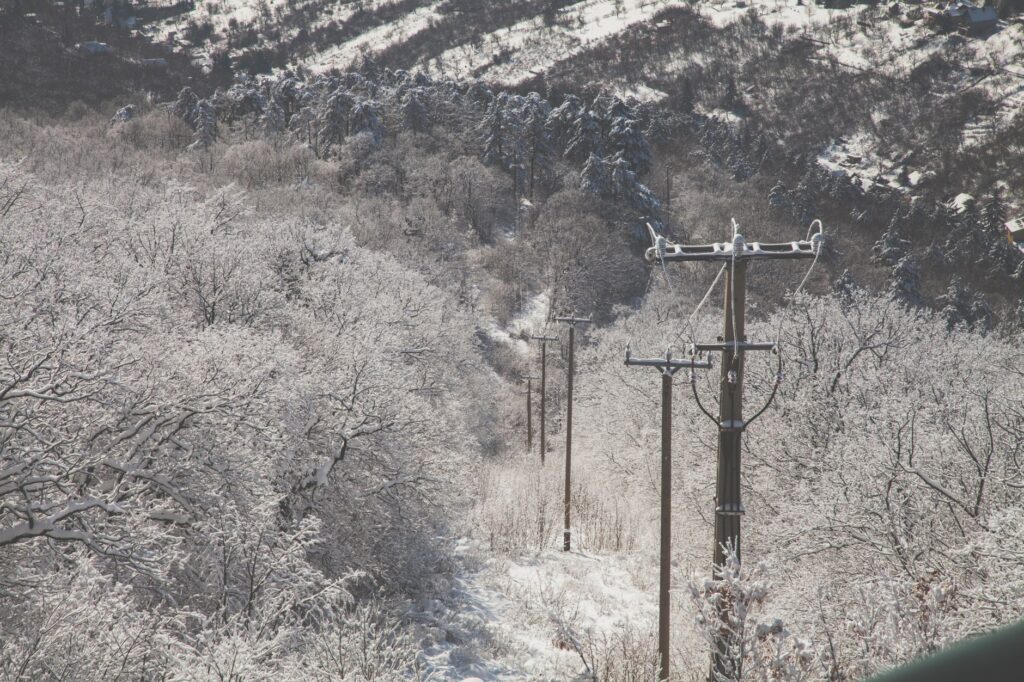
Ice storms start with freezing rain. Snow falls into a layer of above-freezing air and melts to rain, then passes through a thin layer of sub-freezing air near the ground. The drops cool below 32 degrees F without freezing, a state called supercooling. When these supercooled drops hit power lines, tree branches or anything else below freezing, they spread into a film of ice that thickens slowly.
The National Weather Service defines an ice storm as one that leaves at least 0.25 inch of ice on exposed surfaces. Most meteorologists say that amount can add about 500 pounds of weight to each span of line. The ice alone can snap lines and bring down utility poles and even steel-frame pylons. Falling branches add to the damage, and they can also block roads. Ice storms are usually not violent. Many people take them for a gentle rain at temperatures just below freezing.
The same hazard is covered in more detail in our look at thin ice, closed roads and lost power. The Wikipedia pages used here do not give a separate explanation for wet snow, so check National Weather Service forecasts for what a given storm is expected to bring.
Where does the electricity come from, and where can it fail?
Power plants send electricity through high-voltage transmission lines over long distances. Lower-voltage distribution lines then carry it to homes and businesses. Transformers at substations raise or lower the voltage at each stage. According to the Energy Information Administration (EIA), local electric utilities run the distribution system that connects customers to the grid, no matter who generated the power.
A power outage is a complete loss of supply to an end user. Wikipedia lists faults at power stations, damage to transmission lines or substations, short circuits, cascading failures and tripped fuses or breakers among the causes. Severe weather is also on the list.
Outages come in different sizes. A transient fault clears itself, and power returns automatically once the fault is gone. A brownout is a drop in voltage. A blackout is a total loss of power over a wider area for a long time, and it is the most severe type. Depending on the cause and the shape of the network, outages can last from a few minutes to a few weeks.
How do utilities restore power?
Steps differ with the cause of the outage and company policy, but providers generally follow the same sequence after a large, long outage:
- Assess the extent, locations and severity of damage to the electrical system.
- Provide the physical and human resources needed for repairs.
- Prioritize sites and components for repair, based on factors such as how critical the load is and whether resources are available to finish the work.
- Carry out the repairs, then reassess the state of the system.
Wikipedia notes that coordinating this work can be confusing and difficult, especially after a natural disaster. Hospitals, sewage treatment plants and mines usually have standby generators that start automatically when power is lost, and telecommunications systems are required to have emergency power.
Who runs the grid and keeps it balanced?
The EIA says electricity supply must match demand at every moment, and organizations called balancing authorities manage that within each region. Most are electric utilities. If supply and demand fall out of balance, local or widespread blackouts can follow.
The Lower 48 states have three main interconnections that mostly operate independently: the Eastern Interconnection, the Western Interconnection and the Electric Reliability Council of Texas (ERCOT). The North American Electric Reliability Corporation develops and enforces mandatory reliability standards, which the Federal Energy Regulatory Commission (FERC) approves.
Utilities are scored on three measures: System Average Interruption Duration Index, Customer Average Interruption Duration Index and Customer Average Interruption Frequency Index. The first two are measured in minutes.
What should you know about carbon monoxide during an outage?
Wikipedia reports that power losses during ice storms have indirectly caused illnesses and deaths from unintentional carbon monoxide (CO) poisoning. People turn to other ways of heating and cooking during long outages, and gas generators, charcoal and propane barbecues and kerosene heaters contribute to poisonings when they run in confined spaces such as basements and other indoor locations. CO forms when appliances burn fuel without enough oxygen.
At lower levels, CO causes nausea, dizziness, fatigue and headache. High levels can cause unconsciousness, heart failure and death. The same page says losing electricity can also lead to hypothermia and to burst pipes when water freezes inside them.
Can electronics be protected from outages?
Computers, networking equipment, alarm systems and similar devices can lose data or suffer hardware damage when power drops suddenly. An uninterruptible power supply (UPS) keeps electricity flowing for a short time if the main supply fails. A surge protector absorbs excess voltage when power returns, a moment when surges can damage hardware.
Quick answers
How much ice counts as an ice storm?
The National Weather Service uses a threshold of at least 0.25 inch of ice on exposed surfaces.
Do ice storms only happen in the Northeast?
Most U.S. ice storms occur in the northeastern region, according to Wikipedia. A storm in February 1994 built up heavy ice as far south as Mississippi and caused reported damage in nine states.
Where can I see how forecasters rate winter storm impacts?
Our explainer on the Winter Storm Severity Index and NWS warnings shows how impact maps and warnings differ. If a squall catches you on the road, see what officials advise during a snow squall warning.
Checked against official sources in November 2026. Alert criteria, records and guidance are revised: check the official agency page for current information.