Rip Currents Explained: How They Form and How to Avoid Them
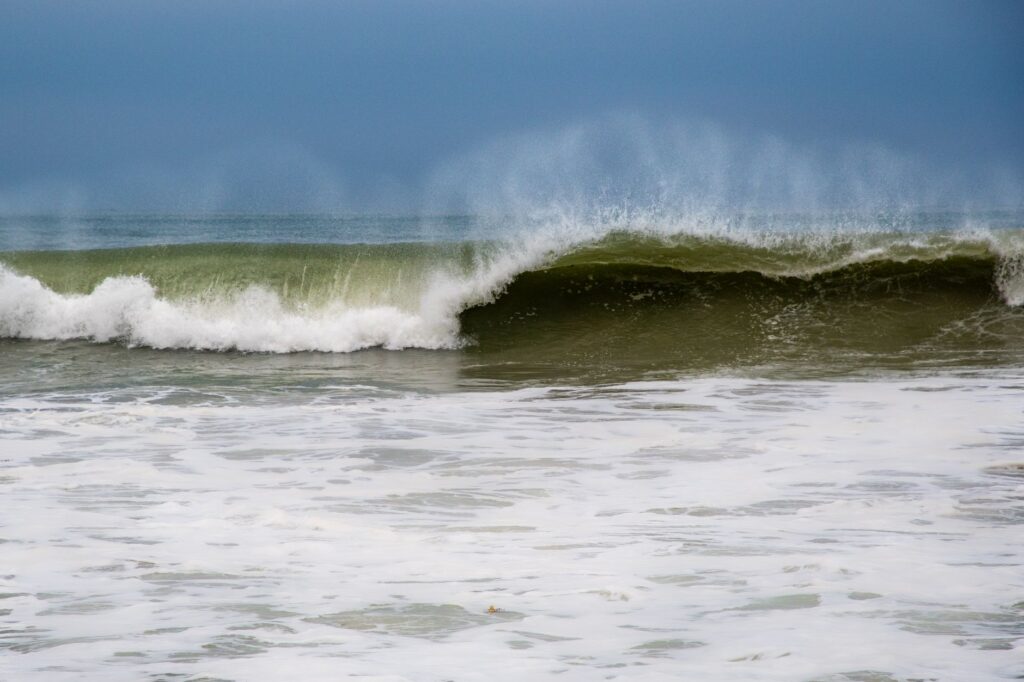
A rip current is a strong, narrow current of water that moves directly away from the shore, cutting through the lines of breaking waves like a river flowing out to sea. It forms near beaches where waves break, and it is strongest and fastest next to the surface. Rip currents are the leading cause of rescues by lifeguards at beaches, and the most reliable protection is to check conditions before going in and to swim only where lifeguards are on duty.
How does a rip current form?
Wind and breaking waves push surface water toward land, which raises the water level slightly along the shore. That extra water flows back out by the easiest route. Where the bottom is a little deeper, for example in a gap in an offshore sandbar or reef, water moves out more easily and a rip starts there.
A rip has three parts, according to Wikipedia’s article on rip currents. Water piled up near the beach runs along the shore toward the outgoing channel as “feeder currents.” The flow leaves the beach at a right angle through a tight channel called the “neck,” where it is fastest. Beyond the breaking waves, the flow spreads sideways, loses power and dissipates in the “head” of the rip.
Rips can form on the coasts of oceans, seas and large lakes whenever waves have enough energy. Sandbars, piers, jetties and crossing wave trains can all make waves break unevenly along a beach, which sets up the conditions for a rip. Once a rip has formed, it may deepen the channel through a sandbar.
Can you predict where a rip current will be?
Not easily. Some rips return to the same spot again and again, while others appear and disappear at different places along a beach. Their appearance depends on the shape of the bottom and the direction of the surf and swells. In areas with a large tidal range, rips may occur only at certain stages of the tide, when the water is shallow enough for waves to break over a bar but deep enough for the broken wave to flow back over it. Measurements at La Jolla, California, found rips that lasted several minutes and recurred one to four times per hour.
Does a calm, sunny day mean the water is safe?
No. The National Weather Service (NWS) warns on its rip current safety page that great weather for the beach does not always mean it is safe to swim or even play in the shallows, and that rips often form on calm, sunny days. The surface of a rip can look like a smooth patch of water with no breaking waves, which can make it look like a good place to enter.
What do people get wrong about rip currents?
Two mix-ups are common.
- A rip is not the same as undertow, the subsurface seaward current of water brought ashore by waves. “Rip tide” is also a misnomer, because rips are driven by waves, not by the tide itself.
- Neither a rip nor undertow can pull a person down and hold them under the water. A rip carries floating objects, including people, out to just beyond the zone of the breaking waves, where the current dissipates and releases what it carries.
The danger comes from panic and exhaustion. Swimmers who do not understand what is happening, or who lack water skills, may panic or tire themselves by swimming straight against the flow. In the United States, rip currents caused an average of 71 drowning deaths per year between 2013 and 2022, according to Wikipedia.
How can you lower the risk before entering the water?
The NWS gives these steps:
- Look at the local beach forecast before leaving for the beach.
- Talk to the lifeguard at the beach about water conditions.
- Swim only at a beach with lifeguards. The NWS cites the U.S. Lifesaving Association for the figure that the chance of drowning at a beach with lifeguards is 1 in 18 million.
The NWS adds that rip currents are not the only deadly beach hazard, and its safety site covers dangerous waves and why swimmers should never turn their backs on the ocean. For instructions on what to do if you are caught in a rip, follow the lifeguard’s directions and the guidance on the NWS page.
How do coastal flood alerts differ from rip current hazards?
Coastal flooding is a separate hazard: seawater submerging dry, low-lying land. According to Wikipedia’s coastal flooding article, seawater can reach land by direct flooding, by overtopping a barrier or by breaching one, and storm surges from hurricanes and tropical cyclones are one cause. Unusually high tides, especially with high winds and storm surge, also flood coasts. The 1953 North Sea flood is an example of that combination, covered in our history of the North Sea flood and the Delta Works.
Tidal flooding, also called sunny day or nuisance flooding, is the temporary flooding of low-lying areas, especially streets, during exceptionally high tides such as those at full and new moons. For how inland flood alerts differ, see flash flood warning versus flood warning. Coastal readers in the Carolinas can also read about hurricanes in North Carolina and National Hurricane Center advisories. For the exact wording and criteria of a local statement or alert, check the National Weather Service forecast office that serves your beach.
Quick answers
Is a rip current the same as a rip tide?
No. “Rip tide” is a misnomer. A rip current is caused by waves and the shape of the bottom, although in areas with a big tidal range it may appear only at certain stages of the tide.
Can a rip current pull you underwater?
No. A rip current carries a swimmer away from shore on the surface, strongest near the top, and releases them just beyond the breaking waves.
Where is the safest place to swim?
The NWS recommends a beach with lifeguards, and checking the local beach forecast and asking the lifeguard before you enter the water.
Checked against official sources in November 2026. Alert criteria, records and guidance are revised: check the official agency page for current information.