How School Districts Decide on a Snow Day: Timing, Buses and Alerts
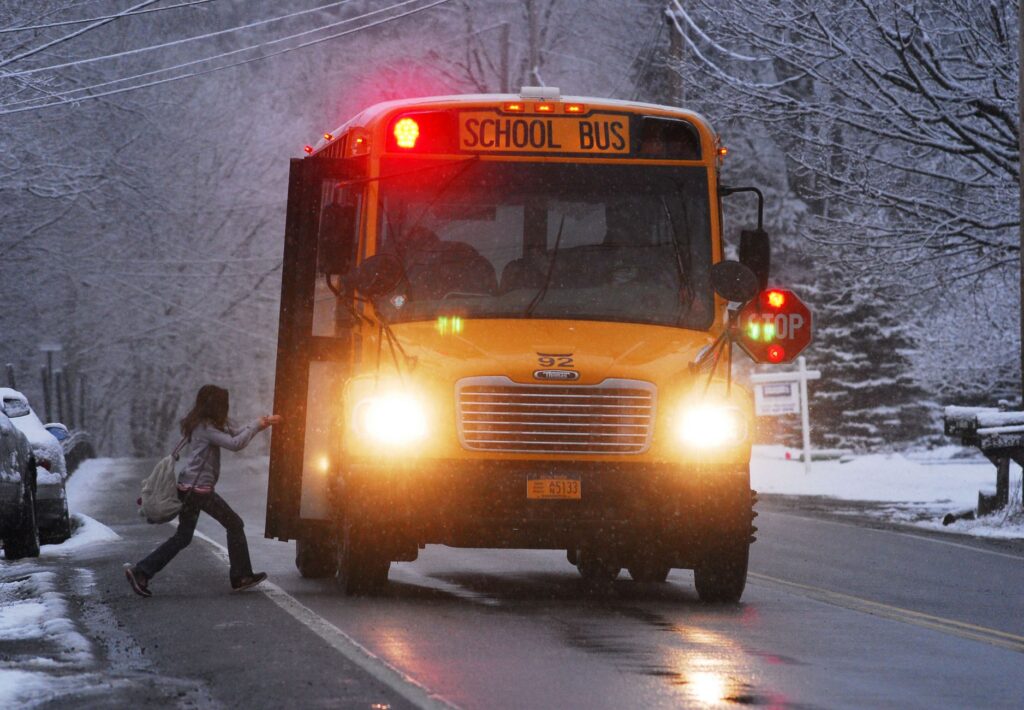
A school district calls a snow day when its buses cannot run their routes safely or when children who walk to school would be in danger. The superintendent or the transportation office makes the call before dawn, and families hear about it early in the morning: Seattle Public Schools sends its robocall and email between 5 and 6 a.m. Each district writes its own rules, so the trigger in one city can be a forecast wind chill and in another the state of the main roads.
What makes a district call a snow day?
Bus safety decides most snow days. The Wikipedia article on weather-related cancellations describes the main criterion in the United States and Canada as the inability of school buses to operate safely on their routes, together with the danger to children who walk. A snow day there means classes are canceled or delayed by snow, heavy ice or extremely low temperatures.
Local experience with snow changes the threshold. According to the same article, an inch or two can make roads unsafe in places less used to snow, such as Atlanta, Dallas, Memphis or Chattanooga. Some large northern metropolitan areas have plow and salt crews that can clear 10 or more inches of overnight snow and ice before the morning commute. In northern parts of the country, snow days tend to come when a storm overwhelms the usual effort to clear main roads, which the article puts at 1 to 2 feet of snow.
Roads are one reason among several. Severe weather can also cut power or leave a building without heat, and the article lists both as grounds for closing.
Who makes the decision, and on what information?
The superintendent usually decides. Saint Paul Public Schools says Superintendent Stacie Stanley consults a variety of experts inside and outside the district before canceling school for extreme winter weather. The district may call off in-person classes if any of these applies:
- Wind chills are forecast to be -35 or colder at 6 a.m.
- Snow makes it too difficult for students and staff to get to school safely.
- The superintendent finds other inclement weather serious enough.
Forecasts come from the local office of the National Weather Service, which issues winter watches, warnings and advisories on local criteria. The agency notes that the amount of snow behind a Winter Storm Warning in the Northern Plains is typically much higher than in the Southeast. A Winter Storm Watch means conditions are favorable for a significant winter storm, and a Winter Storm Warning means travel will become difficult or impossible in some situations. Our report on a winter storm watch issued for Yosemite shows what one of these products looks like, and the guide to lake-effect snow warnings in New York covers the alerts that follow narrow snow bands.
None of the district pages reviewed here publishes a step-by-step account of overnight road inspections. Ask your district’s transportation office how it checks roads before the morning call.
How do bus routes change in snow?
Some districts move buses to snow routes on a late-start day. Seattle Public Schools designs its snow routes so that stops sit on main roads the Seattle Department of Transportation (SDOT) prioritizes to keep clear of snow and ice. A snow route stop may be in a different place from the regular stop. Students with curb-to-curb service may have their stop moved to a location the Transportation Department judges safer.
Seattle mails each family its snow route, stop location and times in December. On a two-hour late start, buses run only for full-day, in-district general education, special education, preschool and Head Start students. Out-of-district transportation does not run, and field trips and sporting events are canceled.
Road clearing sets the limits. SDOT says its crews work 24 hours a day during a severe snowstorm and may need up to 12 hours after a break in the storm to clear all the priority streets.
When is the call made?
Families in Seattle are told between 5 and 6 a.m. The district’s robocall and email, sent through SchoolMessenger, announce one of two outcomes:
- a two-hour late start, with transportation on snow routes
- an inclement weather closure
A delay is unavailable in some districts. Saint Paul Public Schools states that delayed starts and early dismissals are not logistically possible there, so its choice is between holding school and canceling. Montgomery County Public Schools in Maryland lists closures, delayed openings and early dismissals among its options, and weekend decisions there are made by the county’s Interagency Coordinating Board for the use of public facilities.
How are families told?
Districts use several channels at once, and the phone call is often the slowest. Seattle lists its channels in this order:
- Local TV and radio stations, including KOMO 4, KING 5, KIRO 7, FOX 13, KNWN AM 1000 and KIRO 97.3 FM.
- District accounts on Facebook, Twitter and Instagram.
- District and school websites.
- Phone calls, emails and text messages to families.
The district says other channels may be faster to check than the call, email and text.
Montgomery County Public Schools runs Alert MCPS, a free service that sends text or email messages to devices a family registers; the wireless carrier may charge for texts. Its weather messages go out in English and Spanish. Staff take calls from 7:30 a.m. to 5:00 p.m., Mondays through Fridays, in both languages.
Saint Paul uses MessagesXR, which draws contact details from the district’s student information system, Infinite Campus. Families there are asked to keep their contact information current through Campus Parent.
What happens to the missed school day?
Many districts build extra days into the calendar to cover closures. Wikipedia’s article says that once a district uses more snow days than it built in, the days must be made up, for example by shortening spring break or ending the year later. In some states, such as New Jersey, all snow days must be made up.
Saint Paul handles it differently. The first two days it cancels for weather are non-instructional days with no e-learning. After that, the superintendent chooses between an e-learning day and another non-instructional day, and students are told to take their iPads and chargers home every day.
Quick answers
Can school be delayed instead of closed?
That depends on the district. Seattle uses a two-hour late start with snow routes, while Saint Paul says delayed starts and early dismissals are not logistically possible.
How cold does it have to be to cancel school?
There is no national number. Saint Paul Public Schools may cancel if wind chills are forecast to be -35 or colder at 6 a.m. The National Weather Service describes wind chill as a measure of how cold people feel from the combined effect of wind and cold temperatures.
What should families arrange ahead of a storm?
Seattle Public Schools recommends that every family have an emergency weather plan and a neighbor, family member or care center that can receive children if school is delayed or canceled.
Where is my child’s snow route stop?
In Seattle it is in the December mailer and in the parent or guardian Source account. Families who do not receive the mailer are asked to contact Transportation through Let’s Talk.
Checked against official sources in November 2026. Alert criteria, records and guidance are revised: check the official agency page for current information.